On below, I have looked at some artworks which are inspired by human and plants.This helps me to get inspirations for my human hybrid design. Painting: By DaFlln (Devin Fallen): 'Human-Plant Hybrid'
The painting on above is painted in acrylics and colored pencils. The idea of the painting present a human Venus flytrap Hybrid and the artist Devin Fallen has positioned and replaced the mouth with the Venus flytrap and I think it looks very interesting as the shape of the flytrap looks like the human mouth shape, the color inside the flytrap looks like the gum's color and also the cilia looks like sharp teeth. I also like the way how the man in the painting is going to eat the food on the table which makes the character quite eerie and the way there are leaves on the background makes the flytrap looks more realistic as if there wasn't any leaves, the flytrap will only be on the mouth and it will look strange and unrealistic.
By Italian artist, Nunzio Paci
On below is a quote from Nunzio Paci talking about the ideas of her art pieces. 'My whole work deals with the relationship between man and nature, in particular with animals and plants. The focus of my observation is body with its mutations. My intention is to explore the infinite possibilities of life, in search of a balance between reality and imagination..'
Nunzio Paci's painting demonstrates the anatomy of the human body combined with the idea of plants and animals and extend the idea to a further step by using the skeletal structure and the muscular from the human body. I like the idea how the branches and the roots represent the muscular structure of the body and the way sometimes it looks like human veins and wood texture. I found the drawings and paintings very inspiring and fascinating. I like the positioning of the branches on the body and the way how it grow away from the shoulders, the neck and the face. Photography and Editing: By Cal Redback : Photographer and retoucher from Paris, France 'Treebeards' On below are the photos taken and retouched by Cal Redback and the first photo on below is my favourite among the 'Treebeards' photos.
The reason why this is my favourite photograph among 'Treebeards' is because I like how realistic it looks and the way how the thorns are placed on the face which present the features of the roses. I found the thorns looks quite realistic and the way how there are shadow underneath the thorns which makes them appear more three dimensional. I like how the colors around the eyes are quite rust which matches the roses color around the head and rather using bright colors, the rust colors on the face and the color choices of the roses around the body looks more realistic and fascinating. I think for the hairstyle, it links to the roses shape and it shows a clean slick back bun hairstyle.
On above are some more photographs from 'Treebeards' and they are more about grass and leaves on the face and the neck of the character. They all have got similarities as they are placed on one side of the face and extend to the neck. You can still see some of the skin and the structure of the skull, even though the eye has gone and some part of the skin has missing. I found the photos are quite creepy as some part of the human's features have been missing and replaced by leaves or grass, but I think it is very imaginative and creative in the way how plants have involved on human to represent another characters. Sculpture: By Japanese Artist, Ishibashi Yui
The artist Ishibashi Yui has developed the ideas of the relationships of nature and human, how 'the cycle of nourish and depletion that living and dying requires' in the nature world. The work is presented in human and plants form and I think the reason why the body looks pale and white is because maybe Ishibashi Yui wants to present the ideas that the body is also link to earth as well. The artworks on below has got roots, branches and leaves coming out from the body and I think it is a way to show the connections between them. I particular like the last artwork as the girl's hair turns into roots and I found it quite eerie, the way she has got half of her face and the eyes are open. The color green represent the natural world and I like how the branches and the roots go outwards to different directions which shows the idea of you can't expect what will happen next as it is nature. References:
On this blog post, I have found out in Egypt, there are some animal and human hybrid inspired architecture and also characters in their culture. The Great Sphinx at Giza in Egypt
The Great Sphinx at Giza in Egypt is an architecture example of an animal human hybrid. The architecture is a limestone statue and it presents a half human (human head) and half lion (lion's body). In Ancient Egypt, the head represents a God or a Pharaoh while the lion body presents "a lion's strength and dominance to a king's intelligence". An Egyptologist named Henry Fischer have found out that the idea of a human 's head and a lion's body character is to show "the link between mankind and the gods.". The Sphinx statues are built to guard significant places for example: temples and tombs. I like how there are symbolism and background story within the Sphinx statues and I think it is very inspiring as it allows me to understand how I can use and combine specific creatures or their characteristics to create symbolism and tell the background story of the character.
On above is a statue of a winged snake deity from the tomb of Pharaoh Amenhotep II from 1427 to 1400 B.C. As you can see on the photo, the statue has got a snake body, a human head and winged arms. In Egyptian, winged serpents are related to the Kings or Queens and are used to protect or guard them and it symbolised divine authority. It is not known where the idea of winged snake deity comes from ' but among the suggestions that have been put forth are the resemblance of the posture of the snake's neck and anterior of its body to wings when it is excited, the fact that horned vipers throw themselves at their victims, or the resemblance of a shedding snakeskin to wings.'. In Egypt culture, 'the Cobra was assigned to the Pharaohs as a sign of kinship by Keb )a.k.a. Kronos, son of Ouranos).'. I think the idea of using wings for the arms is interesting and the way although the statue has got a snake body, but it stands as straight as a human.
Anubis is a Greek name of a God and is the God of mummification. He is also the God of the underworld and he appears as a canine or a canine's head and a human body. Anubis is black in color and he 'associated with fertility, and was closely linked to rebirth in the afterlife.'. For my human hybrid design, I will need to think of the color choices as well and think about how I use colors to represent the character's characteristics and tell the audience the story behind the character. Overall, I found out that in Egypt cultures, the characters, statues or architecture used either a human head and an animal/s body or an animal head and a human body and I found them very interesting as each character has their background story and also symbolism involved (different animals have their own meanings) which makes the characters more fascinating. References:
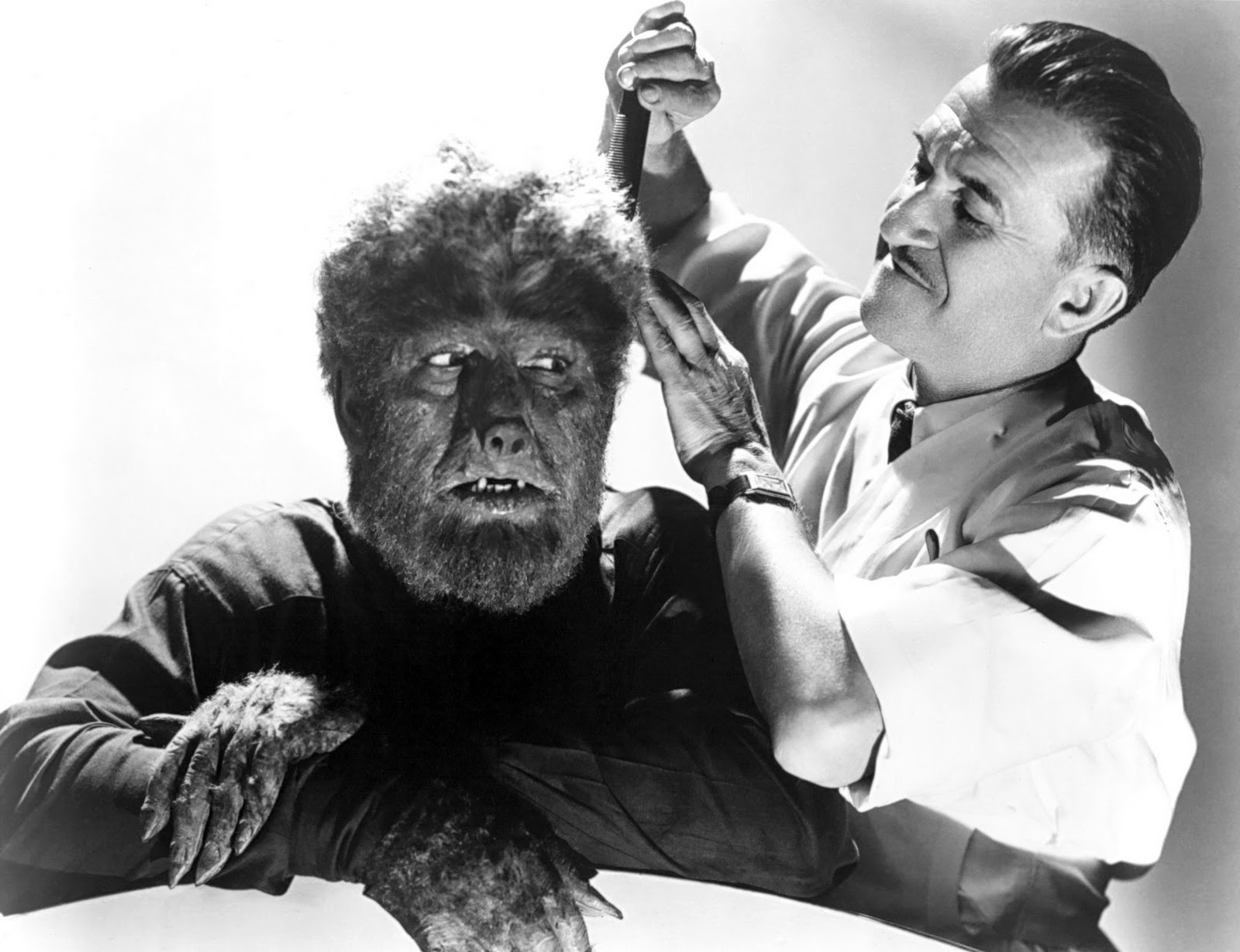
'Werewolf of London' was a 1935 film and is the first Universal horror film about werewolves. The film is about Dr. Glendon who was starred by Henry Hull, becomes a werewolf creature. Because Henry Hull refused to do the makeup for a long period of time, Jack Pierce, the make-up artist and designer has redesigned the makeup for the werewolf character. But in 1941, in the film 'The Wolf Man', Jack Pierce has used his original design of the werewolf character on Lon Chaney Jr. On below shows the version of Lon Chaney Jr's werewolf design from the film 'The Wolf Man' in 1941.
https://scarymotherfucker.files.wordpress.com/2011/07/annex-chaneyjr-lon28frankensteinmeetsthewolfman29_02.jpg Next to the Lon Chaney Jr is the makeup artist, Jack Pierce
In 'Werewolf of London', Dr Glendon's werewolf character has got fake teeth on and I like how there are creases around his mouth which refers to the werewolves features. The brows are cover up but they have stuck some facial hair to create the brow shapes and also it links to the hair texture of the werewolves. There are also creases on his nose and near the brows as well. His ears were being reshaped as well to refer to the ears of the werewolves. There is also contouring under the cheekbones forming an angle to reshape the face of the character. The costume of Dr Glendon is like what human normally wears, coat, suits,etc as he is a human who then transformed into a werewolves human like creature. I like how Jack Pierce has considered sticking some hair on the forehead and change the hair line of Henry Hull to transform into a werewolf. For the hands, it is also hairy and has got sharp fake nails on as well. Compare to the version of Henry Hull, Lon Chaney Jr's werewolf character is more dramatic.and there are more texture on his face as Lon Chaney's face was covered with more hair. For the makeup on the hands, it is quite similar as both of them also looks hairy and have got fake nails on. The fake teeth from both version is similar as well. From the version of Lon Chaney's werewolf, the nose is more realistic and close to the feature of the werewolves' nose. The sharp pointy ears has gone from Lon Chaney's version and I think is because the hair nearly covers up the ears so if there is sharp pointy ears, it will not be seen as clearly. The costume quite similar as well as Lon Chaney wears shirts, etc. 'The Wizard of Oz' (1939)
Jack Dawn is the make-up artist for the lion character for the MGM production of 'The Wizard of Oz' and he was an American make-up artist. He has worked on many films and in 'The Wizard of Oz', he has done the makeup for the lion, the scarecrow and the tin man. Although the lion character is meant to be an non human character, but I found it relevant to our human hybrid project as it shows how the makeup artist transform a human to a lion using the features of the animals. The Cowardly Lion is a wild lion in 'The Wizard of Oz' and he can speak like human because he comes from a fairy region. The makeup of the cowardly and gentle Lion is one of the first primary uses of foamed latex techniques for the makeup. You can see the photo on above, he has got foamed latex around the mouth to create the shape around the lion's mouth and I think it is well thought out as it is just applied on top of the mouth and so the actor can speak easily. The shape of the nose has changed as well to refer to the lion's nose. I like how his head got the lion's ears and also I think is clever that they used curly hair around the head to present a human like lion and the mane on the lion. There are sensory whiskers near the nose and the tip of his nose is painted in black. The actor's eyebrows has been covered up and the makeup artist has stuck bits of hair. The skin tone of the face is more likely to be a human skin tone and for the costume, he wears a hairy body suit. Disney's Stories: In Disney stories, there are several animal human hybrid ideas of characters. On below I have listed a few characters. Little Mermaid (1989)
The character of Ariel in 'Little Mermaid' is an example of a half human, half fish creatures human hybrid. The shells on her chest reference to the sea and the rather than having two legs like human, Ariel has got the fish tail which present the ideas of the mermaid.
In 'Little Mermaid', there is also a character which is inspired by a creature living in the sea which her name is called Ursula. She is a sea witch character and is a half human and half octopus. She has got light lavender skin, white hair shows evilness and also human form, her body shape is similar to an octopus and there are six black color octopus like tentacles. Her costumes and appearances makes her an evil and eerie character. I think maybe the blue eye shadow represents she is a sea creature.
Mickey Mouse from Disney's character is a half human and half mouse character. The way the character can speak and also stand like a human. Mickey Mouse has got the features of the mouse as he has got the tails, the shape of the ears, nose and mouth. He has got the features of human as he wears shoes, shorts and gloves and has got human eyes and skin tone on his face. References:
Kehoe, V. (c1991). Special Make-up Effects. Focal Press.
Timpone, A. (1996). Men, Makeup, And Monsters- Hollywood's Masters of Illusion and Fx. St Martin's Press.
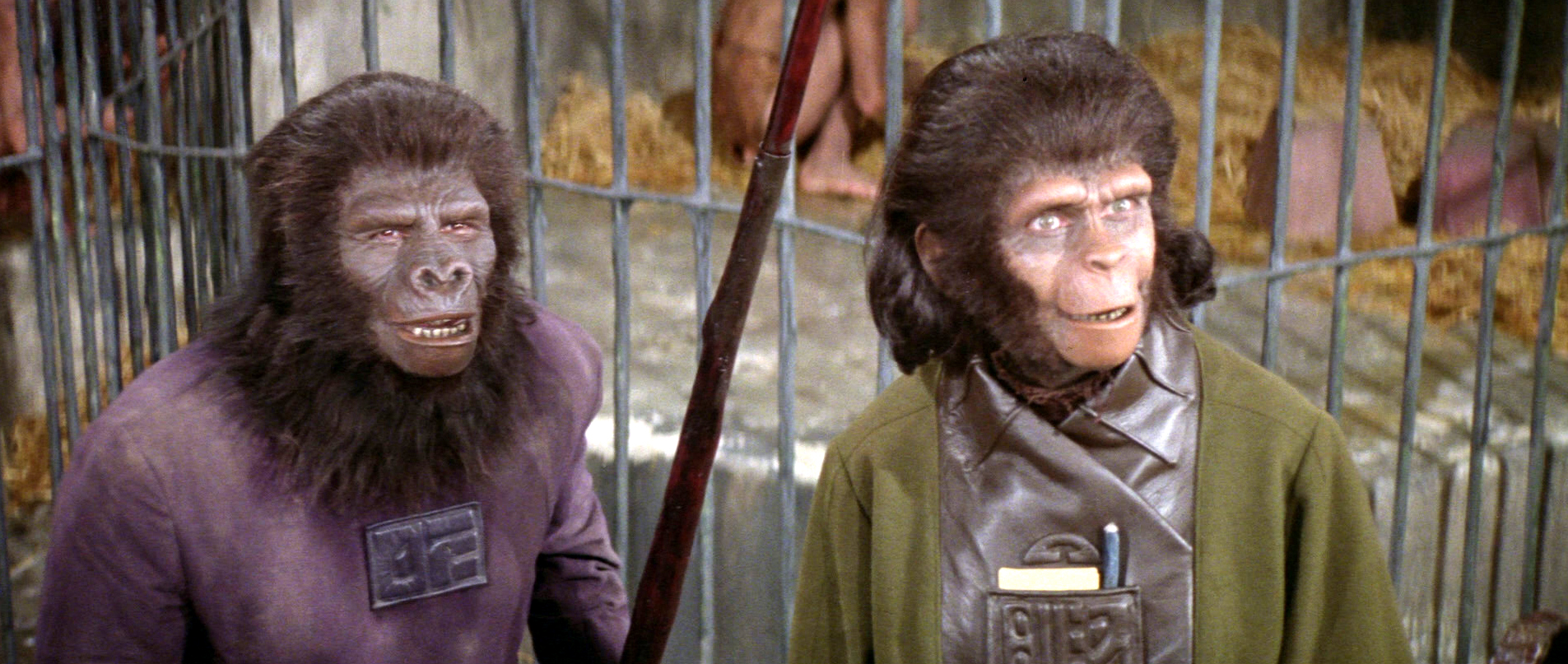
'The Planet of the Apes' is a 1968 film which is about a planet where the apes rules and a dominant while human are the slaves. I found it relevant to our human hybrid project as I want to look at how the makeup artists changed the appearance of a human's face into an animal creature and adapt to the features of the apes. There are gorilla, chimpanzee and orangutan creatures in the film and the apes can speak like a human. John Chambers is the make-up artist for this film and he was an American make-up artist and is an expert in prosthetic makeup for film and television. He received an Academy Honorary Award presented by The Academy of Motion Pictures Art and Sciences in 1968. His famous and well known work include 'The Planet of Apes' in 1968, the television series of 'Star Trek' in 1966 of Spock's character who has got pointy ears, etc. In order to complete the look of the apes appearance, John Chambers has used foam latex pieces and divided into sections for the nose, mouth, forehead, around the eyes and cheek area and apply it onto the face of the speaking apes. A lot of the foam latex pieces were pre-colored before the application and then he used the foundation to blend in the edges. They have also used facial hair and the head hair to hide the edge foam latex pieces. But while the others which didn't speak in the film, he has used slush molded heads instead.
Some of the actors who portrayed the apes have their teeth and lips blackened out and some of them has got false teeth which makes the actor more likely to appear like an ape creature. 'The Planet of the Apes' is the first film which turns the actors into a realistic and believable animal creature and is persuasive as well. The costume which the apes wore is like what human wears and there is a contrast and irony in between the human and the apes in the film as while the apes dressed like a human, but the human dressed as the cave man.
On above, you can see the line and wrinkle details on the apes face and I like how there are a lot of areas on the face which are creased and it links to the apes features. The color of the skin is similar to human skin tone and by changing the shapes around the mouth, the nose and also without eyebrows and enhance the bridge of the brows, it makes the look more persuasive and realistic.
Peter Pettigrew is a half human, half rat character in 'Harry Potter'. The role is played by Timothy Spall and I like the way how he interpret the character and also through his action and appearances, you can see straight away he is a rat human hybrid. On the photos above, you can see the character has got a lot of details which links to the rat such as his hair is quite messy and untidy, he has got fx teeth on as well which matches the features of a rat. Also, he has got sharp dirty black nails and also I think the makeup artists have emphasised his nasolabial folds to make the nose and the teeth stand out more and so this shows the links to the features of a rat. The costume that he wore is quite old and dirty as well, like a street rat.
The role of Firenze the Centaur is played by Ray Feaaron and in 'Harry Potter', he portrayed a centaur character in the film and he has got blue eyes, horse body, ears and also the shape of his face looks like a horse as well. The way there are hair around his face which helps to reshape his appearance. He looks muscular and has got hairs on his body which makes the appearance more realistic.
Lord Voldemort is a human snake hybrid and the role is played by Ralph Fiennes. As you can see on the photos above, his nose is flatten and also he has got no eyebrows which link and match the features of the snakes. I love the folded skin at the back of his neck and also the way the veins on his head created the patterns of the snake. The makeup look very clean and I think the makeup artists want to portray Voldemort as natural and as realistic as the character can be. The skin is pale and I think the reason is that the makeup artists want to stand out the patterns on his head and also the hollows on the eyes. I also like the way the makeup artists emphasis the hollows of the eyes and stand out the heavy bridge bone to create a more eerie and scary looking of the character. He has got fx nails as well a bit sharp and has got weird color and shape which make the character monster like.
The photo on above, you can see Voldemort's teeth is small and looks a bit flat and quite yellowish and I think maybe it is used to show his monster like character and also add eerie feelings to the character.
In the video on above, the producer of 'Harry Potter', David Heyman has discussed about the reason why they didn't used red eyes for Voldemort's look which is written in the book as they wanted to portray a more realistic character and if they used the red eyes for Voldemort, we couldn't read what the eyes were expressing through the character. The costume designer, Jany Temime has talked about Voldemort's costume. She has used thin, floaty, silk fabric and a lot of layers for his outfit and it was spirit and I like how the way the fabric float when Voldemort was walking. Creature and makeup designers, Nick Dudman has talked about the difficulties they have when designing the flatten nose that Voldemort has. As he said in the video, prosthetics make-up can't create the flatten nose part of the character and so they need to digitally removed his nose and remask his nose. There isn't too much makeup on Ralph Fiennes and there is just a prosthetic piece which cover his eyebrows and nothing around his mouth, cheek areas. This helps the character to feel comfortable when they are acting and also it gives more facial expressions to the character.
In 'Harry Potter', mandrake roots has become a creature like a human. They produce high pitched voices and as you can see on above, they have got face, hands, legs and body which looks really realistic and amazing. For me, they look like a baby and mandrake roots hybrid as the voice they produced and also their expressions look like a crying baby. I like the details on its face and body and also how they have roots instead of fingers but still similar to the human hands and fingers. The creases on its face and body links to the features of the roots of how they are rough and has got uneven shapes. There are also leaves at the top and also a bit on the roots face which makes the creature more realistic and persuasive.
After reading the book, A Complete Guide To Special Effects Makeup - Conceptual Creations by Japanese Makeup Artists, I have learnt more about special effects makeup (the techniques and also the process of creating a character) and also how to use different materials to decorate a prosthetic make-up look. I have found out a design which look very interesting and creative and it is named 'The Rose Nymph'.
http://i1.wp.com/hautemacabre.com/wp-content/uploads/2014/06/tumblr_mx8roh4Crp1s8xiv6o2_500.jpg?resize=500%2C822 'Bud and Thorn': The Rose Nymph, Photo taken by: Yosuke Model: Marie, AtushiBeauty Make-up: KeizoCostume by Yuta Okuyama&TOMO
Tomo Hyakutake is the make-up artist and the designer of 'The Rose Nymph' and he was born in 1972 on Iwate Prefecture. He is the owner of Hyakutake Studio, KK and studied special effects makeup at the Nikkatsu Visual Arts Academy. He has participated in different projects such as ''Yokai daisenso'' ("The Great Yokai War"), "Ashura-jo no hitomi" (a.k.a. "Ashura": poster artwork), "Dororo", etc. He also works in television project such as "Yo ni mo kimyo na monogatari" ("Tales of the Unusual") and "Mokuyou no kaidan" ("Ghost Stories on Thursday", etc. His design projects include Casshern (the suits); Yokai daisenso; Dororo; Ashura-jo no hitomi (the conceptual sketch); 13 Doors, the haunted house attraction at the amusement part, Korakuen, etc. The concepts of 'Rose Nymph' is to show innocence and freedom and portray a fey being. The look gives a quite eerie and mystery because of the color of the lighting, the zip in the middle of the body and also the way the character has got arm bandages and stitches on her body. There is red tissue underneath the bandages and it looks like its coming from the white pale skin. The shell shape on her chest reminds me of the mermaid. My favourite part of 'The Rose Nymph' is the ornaments and decorations on the bald cap. For the petals on the head, Tomo has used a thin plastic sheet and cut into scalloped ruffle shapes when it is heated with a heated gun. The edges of the plastic sheet will then curl and ruffle. Then, he hold the heat gun near the cut-out shape and it will shrink. After that, he painted the petal with red acrylic paint. The thorns on the bald cap, arms and shoulders is created by twisting and shaping the papier-mache into the thorn shape. He then applied color on them with acrylic paint and attached them to a plastic sheet coated with latex. After the acrylic paint is dried, he brushed the pros-aide on the bottom of the thorns and placed them onto the bald cap, arms and shoulders. The look also features red long and sharp press on nails. For the make-up, Tomo has used red eye shadow on the corner of the eyes and then blend the color in order to create gradation effects. Then, he has used black eye shadow to contour the eyes and blend the black color over the red color. He has also added pink eye shadow on the lower eyelid and extend it outside the corner of the eye. After that, he has colored the white false lashes in red and then applied it onto the upper and lower eyelids. He has used pink color lipstick for the look. Red contact lenses are being used in this look as well. Branches and thorns: In order to create the branches, he has twisted two or three colored craft wires together with the pilers and then use the glue gun and apply it along the twisted wire. By extending a little bit of the glue into short strands, it can create the thorns shapes. Also you can adjust the shape to make it look like branches as well. Brush Liquitex Ceramic Texture Gel on the wire and then color the branches with acrylic paint. 'The creation of fantastic creatures involves making a foam latex prosthetic and fabricating props and a costume that matches the prosthetic in atmosphere to portray the creature's world.' (Tokyo SFX Makeup Workshop, 2008) This quote shows the importance of how the costumes and props do affect the presentation of the character and when designing or styling the characters' looks, we need to think about how the costumes or props do give specific meanings or give impacts to the looks. References:
Tokyo SFX Makeup Workshop (2008). A Complete Guide To Special Effects Makeup - Conceptual Creations by Japanese Makeup Artists. Published by Graphic-sha Publishing Co., Ltd.